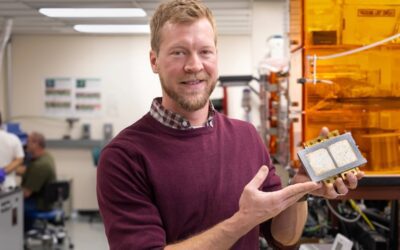


NASA has granted $750,000 to a project aiming to improve high-data-rate communications between satellites and Earth using ultraviolet light, particularly for deep space missions. The project, “III-Nitride Ultraviolet Laser Diodes for Harsh Environments, Space-Based Communications, and Remote Sensing,” is led by Morgan Ware from the University of Arkansas, with contributions from Arkansas State University and Ozark Integrated Circuits Inc.
The goal is to transition from radio to optical wavelengths for space communications, potentially increasing data transfer rates significantly. The team will develop semiconductor laser diodes using nitride materials to create vertical cavity surface emitting lasers (VCSELs). This research could revolutionize satellite communications and enable advanced remote sensing capabilities.
The project involves extensive semiconductor research and aims to ensure the technology can withstand space environments. The findings could transform space exploration by improving data transmission and providing new remote sensing platforms.